ASTRA '90
- Build ID
- LB-ASTRA-90
- Status
- playable
- Genre
- Educational / Astronomy Simulation
- Target
- Early-1990s PC
- Runtime
- Web / Canvas / Web Audio
- Year
- 2026
- Version
- 1.0.2
- Project type
- Local build
- Source
- Not released
Description
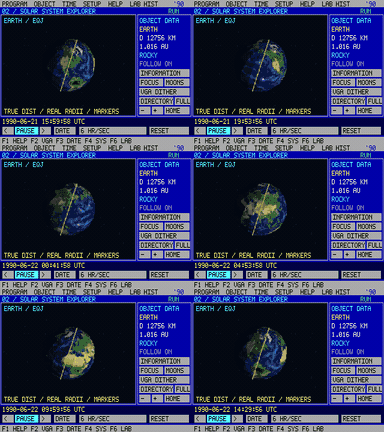
A school astronomy laboratory on a fixed 320×200 VGA screen. Orbit, pan and zoom around the Sun, nine planets and fifteen moons on one clock that runs from 1957 to the end of 1990; run five classroom experiments (day and night, the seasons, Moon phases, eclipses and the retrograde loop of Mars); follow sixteen missions from Sputnik 1 to Mir and Voyager 1 turning back for the Pale Blue Dot; then sit QUIZ.EXE, 22 questions with explanations. Graphics switch between WIREFRAME and textured VGA DITHER, and the display between VGA and SVGA 640×480.
Archive notes
Version 1.0, dated 1990: Disk 02 of the Personal Computer Series, whose Disk 01 is INSIDE.EXE. The two share a bitmap font and window style. The program, its ten-page field manual and quiz are in English and Ukrainian; the Ukrainian edition was prepared in Kyiv in 1990 by the educational methodology group "Vektor", which also translated INSIDE.EXE. The README, in English and Ukrainian, says ASTRA was recovered together with INSIDE.EXE from the hard disk of a retired school computer found at a computer recycling workshop. Its knowledge stops in 1990, so Pluto is still the ninth planet. The photograph viewer holds the original 1990 Pale Blue Dot frame next to a processed VGA copy. Planet positions come from Astronomy Engine; the Pioneer and Voyager tracks are sampled JPL navigation data, and the other routes are marked as teaching approximations. The surviving copy is release 1.0.2.